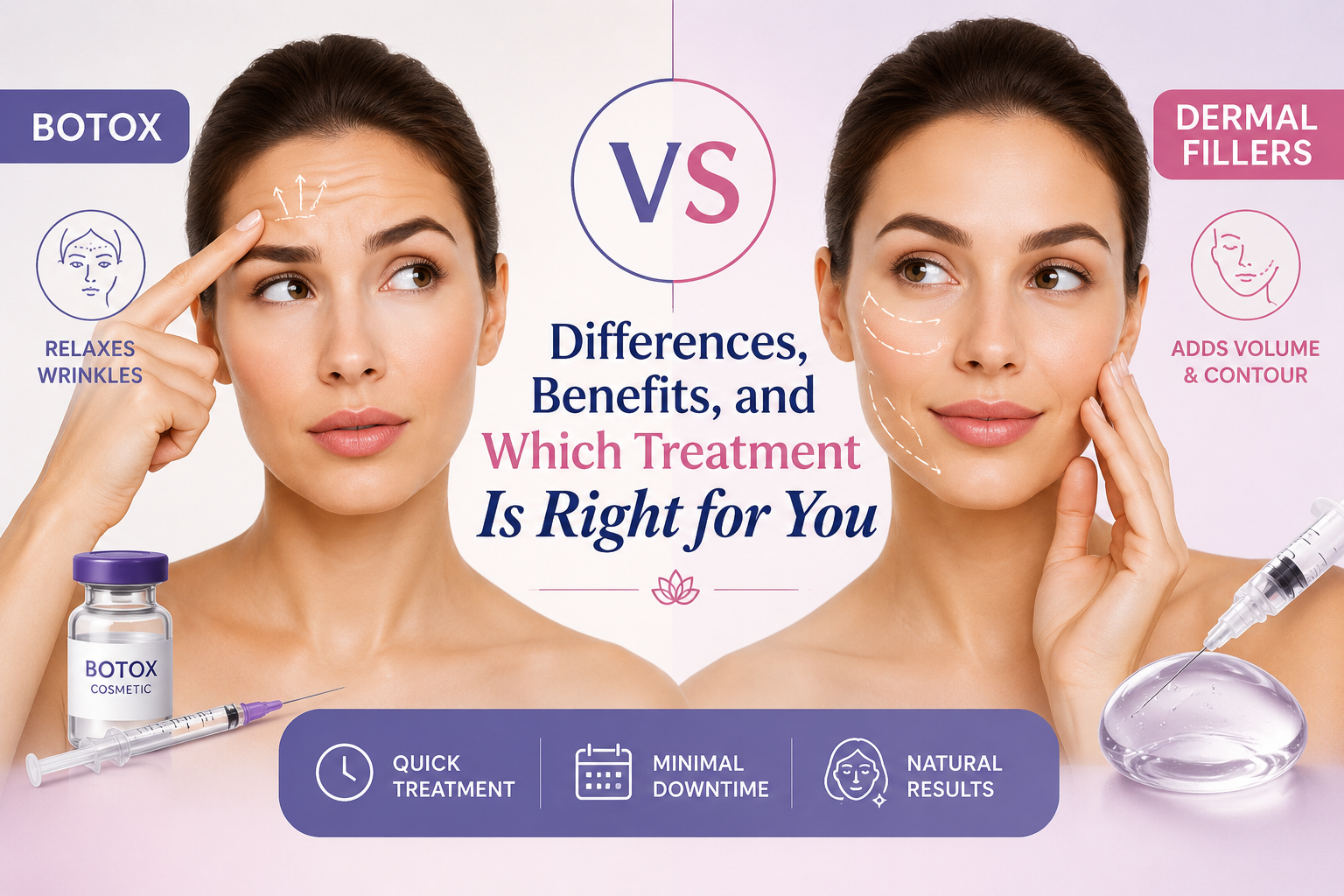
With the rising demand for non-surgical cosmetic enhancements, treatments like Botox and dermal fillers have become the most sought-after solutions for facial rejuvenation worldwide. In recent years, millions of people have turned to these minimally invasive procedures as a practical, affordable, and effective alternative to surgical interventions. Whether you're looking to soften forehead lines, restore youthful plumpness to your cheeks, or simply slow the visible signs of aging, injectables offer impressive results with very little downtime.
These minimally invasive procedures deliver quick results, minimal recovery time, and a reliable way to address common signs of aging such as wrinkles, fine lines, hollow contours, and volume loss. While both Botox and dermal fillers are widely used and are often grouped together under the umbrella of "cosmetic injectables," they serve fundamentally different purposes and work through entirely different mechanisms.
Botox works by relaxing specific facial muscles responsible for causing dynamic wrinkles — those lines that appear when you smile, frown, squint, or raise your eyebrows. Dermal fillers, on the other hand, focus on restoring lost volume, enhancing facial contours, and smoothing deeper, static lines that remain visible even when your face is at rest. Understanding this core distinction is not just helpful — it's essential for selecting the right treatment based on your unique facial concerns and aesthetic goals.
Choosing between Botox and fillers isn't about which is universally better. It's about which is better suited to your specific needs, concerns, and desired outcomes. In many cases, a carefully planned combination of both treatments delivers the most natural, comprehensive, and balanced results. In this guide, we break down the key differences, benefits, treatment areas, longevity, safety profiles, and expected outcomes to help you make a fully informed decision about your aesthetic journey.
What Is Botox?
Botox is one of the most recognizable names in cosmetic medicine, and for good reason — it has decades of clinical use behind it and an established track record of safety and efficacy. At its core, Botox is a purified form of botulinum toxin type A, a protein derived from the bacterium Clostridium botulinum. When used in highly controlled, medically approved doses, this protein has the remarkable ability to temporarily relax targeted facial muscles by blocking the nerve signals that cause them to contract.
When a qualified practitioner injects Botox into a specific facial muscle, it interrupts the communication between the nerve endings and the muscle fibers. As a result, that muscle is temporarily unable to contract with its usual force or frequency. This relaxation effect directly causes the overlying skin to smooth out, reducing the appearance of lines and wrinkles that form as a result of repetitive facial movements over time.
It's important to understand that Botox does not affect all facial muscles — only the precisely targeted ones. This is why a skilled injector can produce subtle, natural-looking results rather than the "frozen face" appearance that many people fear. The goal is never to eliminate all movement but to reduce the excessive muscular activity that leads to visible creasing of the skin.
The types of wrinkles most successfully treated with Botox are known as dynamic wrinkles — those caused by muscle movement rather than gravity or volume loss. These include:
- Forehead lines — horizontal creases that appear when you raise your eyebrows
- Frown lines (glabellar lines) — the vertical "11" lines that form between the eyebrows when you scowl
- Crow's feet — the fine lines that fan out from the outer corners of the eyes when you smile or squint
Beyond cosmetic uses, Botox is also widely used medically to treat conditions such as excessive sweating (hyperhidrosis), chronic migraines, jaw clenching (bruxism), and muscle spasms — further affirming its safety profile when administered correctly.
Advantages of Botox Injection Treatment
Botox has earned its place as one of the most popular non-surgical cosmetic treatments in the world, and this popularity is backed by a long list of tangible, proven benefits. Understanding what makes Botox such an attractive option can help you decide whether it aligns with your expectations and lifestyle.
Reduces Lines Caused by Muscle Movement: One of the most significant benefits of Botox is its precision. It specifically targets the dynamic wrinkles caused by repetitive facial muscle contractions — the very wrinkles that most people notice first and find most frustrating. By gently relaxing these muscles, Botox smooths out existing lines and prevents them from deepening over time.
Prevents Future Wrinkle Formation: Many people start Botox as a preventative measure rather than waiting until wrinkles become deeply set. When muscles are periodically relaxed through Botox treatments, the skin is given a chance to rest and recover, slowing the rate at which new wrinkles form. This makes Botox particularly popular among people in their late 20s and early 30s who want to get ahead of the aging process.
Quick Procedure with No Recovery Time: A full Botox session typically takes no more than 10 to 15 minutes. There is no anesthesia required, no hospital stay, and no recovery period afterward. Most people have their treatment done during a lunch break and return to their normal daily activities immediately. This convenience factor is a major reason why Botox has become so mainstream.
Highly Customizable Results: Because Botox can be injected in varying doses across multiple targeted points, the treatment is entirely customizable. Your practitioner can tailor the amount of relaxation to match your facial anatomy, aesthetic preferences, and desired level of expressiveness — ensuring results that look natural and balanced rather than overdone.
Proven Safety Record: With millions of treatments performed annually around the world and decades of clinical use, Botox has one of the most thoroughly researched safety profiles in aesthetic medicine. When administered by a trained and licensed professional, it is considered extremely safe with minimal risk of serious complications.
Benefits of Dermal Fillers
Dermal fillers represent a different but equally powerful approach to facial rejuvenation. While Botox works by relaxing muscles, dermal fillers work by physically adding volume and structure to areas of the face that have lost fullness, definition, or elasticity over time. Most modern dermal fillers are formulated with hyaluronic acid (HA), a naturally occurring substance found throughout the human body — particularly in the skin, joints, and connective tissues.
Hyaluronic acid has a unique ability to attract and retain water molecules, which is why it plays such a critical role in keeping skin plump, hydrated, and youthful. As we age, the body's natural production of hyaluronic acid declines significantly, contributing to the hollowing of the cheeks, the thinning of lips, the deepening of facial folds, and an overall loss of the smooth, rounded contours associated with youth.
When injected into specific areas of the face, HA-based fillers instantly replenish lost volume, restore structural support, and smooth the surface of the skin. The results are immediate and can be remarkably natural-looking when performed by an experienced injector. Additionally, hyaluronic acid fillers have the added benefit of being reversible — an enzyme called hyaluronidase can dissolve the filler quickly if a patient is unhappy with the results or experiences a complication.
Beyond volume restoration, dermal fillers also stimulate the skin's own collagen production over time, which means that consistent treatment can yield cumulative improvements in skin quality and firmness. They are also available in a range of formulations with varying consistencies, allowing practitioners to select the right product for each specific area and treatment goal.
Where Is a Dermal Fillers Treatment Applied?
Dermal fillers are highly versatile and can be used to address a wide range of facial concerns across multiple areas of the face. Unlike Botox, which is limited to areas where muscle relaxation can improve appearance, fillers can be strategically placed virtually anywhere that volume, definition, or smoothness is needed.
Cheek Restoration: The cheeks are one of the primary areas where age-related volume loss becomes most apparent. Over time, fat pads in the midface descend and diminish, causing the cheeks to flatten and the face to take on a more tired or gaunt appearance. Dermal fillers can restore the rounded, lifted contours of youthful cheeks, often providing an immediate "lifted" effect without any surgery.
Lip Enhancement: Fillers are widely used to add volume, definition, and symmetry to the lips. Whether you want a subtle enhancement or a more noticeable increase in fullness, lip fillers can be customized to your preferences. They can also be used to define the cupid's bow, reduce fine vertical lines around the mouth, and improve the overall shape and proportion of the lips.
Smoothing Nasolabial Folds: The deep lines running from the sides of the nose to the corners of the mouth — known as nasolabial folds or "smile lines" — are a common concern. Fillers can soften and smooth these lines by adding support and volume beneath the skin in the surrounding areas.
Under-Eye Hollows (Tear Troughs): The delicate area beneath the eyes is particularly prone to developing hollow, shadowed depressions that can make a person look perpetually tired. Strategic filler placement in this area can dramatically reduce the appearance of dark circles and hollowness.
Chin and Jawline Reshaping: Fillers can be used to add projection and definition to a receding chin, sharpen the jawline, and improve overall facial balance and symmetry without the need for surgical implants.
What Is the Main Difference Between Botox and Dermal Fillers?
This is perhaps the most fundamental question in cosmetic injectable medicine, and the answer lies in understanding the two entirely different mechanisms by which each treatment works. Both Botox and dermal fillers are anti-aging injection treatments, but their approaches, target concerns, and outcomes are distinct in every meaningful way.
Mechanism of Action: Botox works neurologically — it blocks the nerve signals that tell specific facial muscles to contract. This results in temporary muscle relaxation and the smoothing of wrinkles that are caused by that muscular activity. Dermal fillers, in contrast, work physically and volumetrically — they are literally injected into or beneath the skin to fill space, add structure, and restore lost volume.
Type of Wrinkles Addressed: This is perhaps the clearest difference between the two treatments. Botox is specifically designed to treat dynamic wrinkles — lines that appear or deepen during facial movement, such as smiling, frowning, or squinting. Dermal fillers, on the other hand, are used to address static wrinkles — lines and folds that are present even when the face is completely at rest. Trying to treat static wrinkles with Botox or dynamic wrinkles with fillers will produce disappointing results, which is why accurate diagnosis and appropriate treatment selection are so critical.
Onset of Results: Botox results are not immediate — the muscle relaxation effect gradually develops over 3 to 5 days, with full results visible after 7 to 10 days. Filler results, by contrast, are immediate — the added volume is visible as soon as the injection is complete, though slight swelling may initially make results appear more dramatic than the final outcome.
Duration of Effects: Botox results typically last 3 to 6 months, while dermal fillers can last anywhere from 6 to 18 months depending on the product used and the area treated.
In summary: Botox relaxes; fillers restore. Both are valuable tools, and both serve a purpose — but they serve different ones.
What Areas Can Be Improved?
Understanding the specific treatment zones for each injectable helps patients set realistic expectations and allows practitioners to develop a comprehensive, strategic treatment plan tailored to each individual's facial anatomy and aesthetic goals.
Botox Treatment Areas:
Botox is most effective in the upper third of the face, where dynamic wrinkles caused by expressive muscle movements are most prominent. The classic Botox zones include the forehead (horizontal lines caused by raising the eyebrows), the glabella (the frown lines between the eyebrows, often called the "11s"), and the periorbital area (crow's feet at the outer corners of the eyes). Beyond these three core zones, Botox can also be used more subtly in the lower face for treatments such as a "lip flip" (slightly rolling the upper lip outward for a fuller appearance), softening a "gummy smile," reducing dimpling in the chin, and relaxing the platysmal bands in the neck — sometimes called a "Nefertiti lift."
Dermal Filler Treatment Areas:
Fillers are most commonly used in the mid and lower thirds of the face, where volume loss and structural changes are most impactful. Primary filler zones include the cheeks, lips, nasolabial folds, marionette lines (the lines that run from the corners of the mouth down to the chin), the chin, the jawline, and the tear trough area beneath the eyes. Fillers can also be used for non-surgical nose reshaping (rhinoplasty), temple filling, and hand rejuvenation.
Because Botox and fillers tend to target different facial regions, they are naturally complementary — a full-face treatment plan frequently incorporates both.
Am I a Suitable Candidate?
Determining whether you are a suitable candidate for Botox, dermal fillers, or a combination of both involves a thorough evaluation of your health history, facial anatomy, aesthetic concerns, and personal goals. While these treatments are appropriate for a wide range of individuals, there are certain criteria and considerations that should be carefully assessed before proceeding.
General Candidacy Criteria:
You may be a good candidate for cosmetic injectables if you have visible wrinkles, fine lines, or facial creasing that bothers you, if you are experiencing volume loss or flattening of facial contours, or if you are interested in non-surgical improvements with minimal recovery time. Candidates should be in good general health, free from active skin infections or inflammation in the treatment area, and not currently pregnant or breastfeeding.
Realistic Expectations Are Essential: One of the most important qualities of a good candidate is having realistic, well-informed expectations about what these treatments can and cannot achieve. Botox and fillers can produce remarkable improvements, but they are not permanent solutions, and they cannot replicate the results of surgical procedures such as facelifts or blepharoplasty. A responsible practitioner will always discuss expected outcomes honestly and transparently.
Medical Contraindications: Certain medical conditions and medications may disqualify a person from receiving injectables or require special precautions. These include neuromuscular disorders (for Botox), blood-thinning medications, severe allergies (particularly to lidocaine or bacterial proteins), and autoimmune conditions. A thorough medical consultation prior to any treatment is not just recommended — it is absolutely essential for your safety.
Age Considerations: While there is no strict age minimum or maximum for these treatments, the appropriate treatment type and approach will vary depending on your age, the degree of facial aging present, and your individual anatomy. Your practitioner will assess all of these factors to design a plan that is right for you specifically.
How Are These Procedures Performed?
One of the many advantages of Botox and dermal filler treatments is that they are straightforward, efficient, and performed entirely in an outpatient clinical setting — no operating theater, no general anesthesia, and no hospital stay required.
Pre-Treatment Preparation:
Before either procedure, your practitioner will begin with a thorough consultation and facial assessment. The treatment area will be cleansed thoroughly to minimize infection risk. For patients who are particularly sensitive to discomfort, a topical numbing cream (typically containing lidocaine) is applied to the skin approximately 20 to 30 minutes before the injections begin. This significantly reduces any sensation during the procedure. Ice packs may also be used to numb the area immediately before injection.
The Injection Process:
For Botox, a very fine needle is used to inject small, precise amounts of the solution into the targeted muscles. Multiple injection points may be used across each treatment area to ensure even, natural-looking results. The process is relatively quick, and most patients report only mild discomfort — often described as a brief pinching sensation. The entire Botox treatment is typically completed in 10 to 20 minutes.
For dermal fillers, the injection technique varies depending on the area being treated and the consistency of the filler being used. Some practitioners use needles while others prefer cannulas (blunt-tipped flexible tubes) for certain areas, as cannulas can reduce bruising and allow for more precise placement in sensitive zones like the tear troughs and lips. A single treatment session typically takes between 20 and 45 minutes, depending on how many areas are being addressed.
Post-Treatment:
There is no significant downtime following either treatment. Minor redness, swelling, or bruising at the injection sites may occur but typically resolves within a few days. Patients are advised to avoid rubbing or massaging the treated areas immediately after treatment and to follow any specific aftercare instructions provided by their practitioner.
Why Have These Procedures Gained Popularity?
The explosive growth in demand for cosmetic injectables over the past two decades is not a passing trend — it reflects a fundamental shift in how people approach personal wellness, confidence, and appearance. Several interconnected factors have contributed to the mainstream acceptance and widespread adoption of Botox and dermal filler treatments.
Accessible, Convenient, and Time-Efficient: Unlike surgical procedures that require weeks of recovery and carry significant risks, injectable treatments can be completed during a lunch break. The entire process from consultation to completion often takes under an hour, and patients can return to work and social activities the same day. For busy professionals, parents, and anyone with a demanding schedule, this convenience is enormously appealing.
Lower Risk Profile Compared to Surgery: The risks associated with surgical cosmetic procedures — including anesthesia complications, infection, scarring, and extended recovery — are simply not present with injectables when they are performed by qualified professionals. The non-invasive nature of these treatments makes them far more accessible to people who want aesthetic improvements but are not comfortable with or not suitable for surgery.
Results That Look Natural: Advances in injection techniques, product formulations, and practitioner training have made it increasingly possible to achieve very natural-looking outcomes. The stigma of the "overdone" injectable look — while still a concern if treatments are performed by unqualified providers — has diminished significantly as more skilled practitioners prioritize subtle, balanced enhancement.
Growing Social Acceptance and Visibility: The normalization of cosmetic treatments in popular culture, on social media, and among public figures has reduced the stigma associated with seeking aesthetic enhancement. More people feel comfortable discussing and pursuing these treatments openly than ever before, further driving demand.
Choosing a Procedure Correctly
Perhaps the single most important principle in aesthetic injectable treatment is that there is no one-size-fits-all solution. Every person's face is unique — with its own bone structure, fat distribution, skin quality, muscular patterns, and aging characteristics — and every person's aesthetic goals are equally unique. Selecting the wrong treatment, or having the right treatment administered without proper assessment, will almost inevitably lead to suboptimal results.
This is why a thorough, individualized consultation with a qualified and experienced practitioner is not optional — it is the cornerstone of safe, effective injectable treatment. During your consultation, a skilled practitioner will:
Conduct a Comprehensive Facial Analysis: Your practitioner will carefully evaluate your facial anatomy, assessing your bone structure, the distribution and descent of fat compartments, the quality and laxity of your skin, and the patterns of muscular activity that are contributing to your areas of concern. This analysis informs which treatment — or combination of treatments — will be most effective.
Listen to Your Concerns and Goals: Beyond the physical assessment, understanding what you want to achieve is equally important. A good practitioner will take the time to listen carefully to your concerns, understand which aspects of your appearance you find most bothersome, and discuss your expectations for treatment in a realistic and honest way.
Recommend a Personalized Treatment Plan: Based on the assessment and your stated goals, your practitioner will recommend a specific treatment approach — whether that means Botox alone, fillers alone, or a strategic combination of both. They will also discuss which products will be used, how many units or syringes are anticipated, and what the expected results and timeline will look like.
Prioritize Natural, Balanced Results: A reputable practitioner will always prioritize results that look natural and harmonious with your existing features rather than dramatic, obvious changes that alter your fundamental appearance.
Longevity of Effect, and How to Choose the Right Procedure
Understanding how long you can expect your results to last is a critical component of treatment planning. Both Botox and dermal fillers are temporary treatments, and maintaining your results requires periodic touch-up appointments. The frequency and cost of these maintenance sessions should be factored into your decision-making process from the outset.
Botox Injection Results:
After receiving Botox, you won't see results immediately. The botulinum protein needs time to work its way into the muscle fibers and begin blocking nerve transmission. Most patients start to notice the first signs of muscle relaxation between 3 and 5 days post-injection, with the full results becoming clearly visible after 7 to 10 days. During this period, the targeted lines and wrinkles gradually soften as the underlying muscles relax. The results appear progressive and natural — a subtle smoothing rather than a sudden, dramatic change.
At full effect, the treated muscles are relaxed but not completely immobile. You will still be able to make natural facial expressions — you simply won't have the excessive, repetitive muscle contractions that were causing or deepening your wrinkles. As the weeks and months pass, the botulinum protein gradually breaks down and is metabolized by the body. Muscle activity slowly returns, and the wrinkles begin to reappear. This typically occurs between 3 and 6 months after treatment.
Dermal Filler Results:
One of the most appealing aspects of dermal filler treatment is the immediacy of results. As soon as the filler is injected, the volume is added and the changes are visible. However, it's important to note that there is typically some degree of swelling immediately following the procedure, which can initially make the results appear more pronounced than the final outcome. Once this swelling subsides — usually within 48 to 72 hours — the true, settled results become apparent. At this point, the volume enhancement, improved contours, and smoothed lines look fully natural.
Filler results are longer-lasting than Botox, but the duration varies depending on the type of product used, the area treated, and individual metabolic factors. In general, HA fillers last between 6 and 18 months. Areas of high mobility — such as the lips — tend to break down filler more quickly, often requiring touch-ups at 6 to 12 months. Areas of lower mobility — such as the cheeks and chin — typically retain filler for longer.
Longevity of Non-Surgical Facial Rejuvenation Results
A thorough understanding of treatment longevity helps patients plan their aesthetic maintenance schedules and budget accordingly. One of the most common misconceptions about injectable treatments is that they are permanent — in reality, all currently available Botox and HA filler treatments are temporary, and results will gradually diminish over time as the products are naturally metabolized by the body.
Botox Effectiveness:
Botox results generally last between 3 and 6 months for most patients. The variation in duration is influenced by factors such as the dose administered, the individual patient's metabolism, the strength of the treated muscles, and how frequently the patient has received prior Botox treatments. Interestingly, patients who receive Botox consistently over several years often find that their results last progressively longer over time — this is thought to be because the targeted muscles weaken slightly with repeated relaxation, requiring fewer touch-ups to maintain the desired effect. To sustain results, most patients schedule Botox appointments approximately 3 to 4 times per year.
Duration of Dermal Filler Treatment Effects:
Dermal fillers offer longer-lasting results than Botox, making them a more durable investment in facial rejuvenation. The longevity of filler results depends heavily on the specific product used (different formulations are designed for different densities and durations), the area treated, and the individual patient's metabolism. On average, most HA fillers last between 6 and 18 months. Lip fillers typically need to be refreshed every 6 to 12 months due to the high degree of movement in that area. Cheek and chin fillers can often last 12 to 18 months or sometimes longer before a touch-up is needed. Over time, HA fillers are gradually broken down and absorbed by the body through natural enzymatic processes, with results fading gently rather than disappearing suddenly.
Are Botox and Dermal Filler Treatments Safe?
Safety is understandably the primary concern for the vast majority of people considering cosmetic injectable treatments. The short answer is yes — when performed by a qualified, experienced practitioner using approved, pharmaceutical-grade products, both Botox and dermal fillers are considered very safe procedures with an excellent overall safety record.
Key Factors That Determine Safety:
The safety of injectable treatments is not inherent to the products alone — it is heavily dependent on who is administering them and how. A licensed medical professional (physician, nurse practitioner, or dentist with appropriate aesthetic training) with specific expertise in facial anatomy and injection technique is the most important safeguard against complications. Using high-quality, clinically tested, and regulatory-approved products is equally critical. Substandard or counterfeit products sold by unlicensed providers represent a serious and growing safety concern.
Common Minor Side Effects:
Like any medical procedure involving needles, both Botox and filler treatments carry a risk of minor, short-lived side effects at the injection sites. These commonly include localized swelling, redness, mild bruising, and slight tenderness. These effects are entirely normal and expected, and in the vast majority of cases, they resolve on their own within 24 to 72 hours with no intervention required.
Rare but Possible Complications:
More significant complications are uncommon but possible, particularly when treatments are performed by inadequately trained providers or when products of questionable quality are used. These include uneven or asymmetrical results, localized infection, granuloma formation, and in very rare cases, vascular occlusion (blockage of a blood vessel) if filler is inadvertently injected into or adjacent to a vessel. This underscores the critical importance of always choosing a qualified and experienced practitioner for any injectable treatment.
Can They Be Used Together?
Yes — and in fact, combining Botox and dermal fillers is not only safe but is widely regarded as the gold standard approach to comprehensive non-surgical facial rejuvenation. Rather than viewing these two treatments as alternatives, it is more accurate and more useful to think of them as complementary tools that each address different but often coexisting aspects of facial aging.
This combination approach is often referred to as a "liquid facelift" or full-face non-surgical rejuvenation, and when thoughtfully planned and expertly executed, it can deliver truly transformative results that target multiple signs of aging simultaneously.
How Combination Therapy Works:
A typical combination treatment plan might involve using Botox to smooth and prevent dynamic expression lines in the upper face — such as forehead lines and crow's feet — while using fillers to restore volume to the midface, enhance the lips, define the jawline, or smooth deep static folds in the lower face. Because these treatments address different structural and functional aspects of aging, they work synergistically rather than redundantly.
Benefits of Combining Both Treatments:
Using both treatments together produces more comprehensive results than either treatment alone. The combination addresses both the muscular causes of wrinkles and the structural changes — volume loss, contour changes — that contribute to an aged appearance. The results are more balanced, more natural-looking, and more complete. Patients who combine both treatments often report higher satisfaction than those who use only one, because the combination addresses the full spectrum of their aging concerns in a single treatment plan.
Which Treatment Should You Go For?
Ultimately, the decision between Botox and dermal fillers — or a combination of both — comes down to a clear understanding of what is causing your specific concerns and what outcome you want to achieve. While a qualified practitioner will always guide this decision based on their professional assessment of your face, having a foundational understanding of each treatment's strengths will help you go into your consultation as an informed and empowered patient.
Choose Botox if your primary concerns are:
Horizontal forehead lines that appear when you raise your eyebrows, frown lines or "11s" between the eyebrows, crow's feet at the outer corners of the eyes, fine lines around the mouth caused by pursing the lips, or any wrinkles that are clearly more visible or pronounced during facial movement than at rest. If your skin still has good elasticity and volume but is marked by dynamic expression lines, Botox is likely the most targeted and effective solution.
Choose Dermal Fillers if your primary concerns are:
Flattened or hollowed cheeks, thinning or asymmetrical lips, deep nasolabial folds or marionette lines, under-eye hollowness or dark circles, loss of chin projection or jawline definition, or any area where the primary issue is lost volume or reduced structural support rather than muscular activity. If your face has a deflated or gaunt quality even when at rest, fillers will address the root cause in a way that Botox simply cannot.
Most Commonly — Consider a Combination: For many patients, particularly those in their late 30s and beyond, the optimal outcome comes from a strategically designed combination of both treatments. The face ages on multiple levels simultaneously — muscles become more expressive over time, fat is lost, bone recedes, and skin loses elasticity. A comprehensive plan that addresses all of these dimensions will produce the most satisfying, natural-looking, and long-lasting results.
Natural-Looking Results
In modern aesthetic medicine, the benchmark of excellence is not how dramatic or obvious a result appears — it is how natural, balanced, and authentic the improvement looks. The goal of Botox and dermal filler treatment, when performed by skilled hands with a careful eye, is never transformation. It is enhancement — subtle, intelligent refinement that helps you look like the best, most rested, most vibrant version of yourself.
The overarching principle guiding responsible cosmetic injectable treatment is to preserve what makes your face uniquely yours while gently addressing the specific changes that are making you look tired, older, or less confident than you feel. This means maintaining the full range of your natural facial expressions, honoring your facial symmetry and proportions, and avoiding the temptation to chase an idealized aesthetic that doesn't harmonize with your individual anatomy.
When treatment is performed correctly, the people around you should be unable to identify exactly what has changed — they should simply feel that you look refreshed, healthy, and well. You should still look like yourself, just at your very best. Overdone, obviously "done" results — the frozen forehead, the overly plump lips, the apple-like cheek contours — are invariably the product of excessive product use or poor technique, not the inevitable outcome of these treatments done right.
This is precisely why choosing the right practitioner matters so enormously. The artistry and restraint of an experienced, skilled injector is what separates a beautifully subtle result from one that looks artificial or excessive. Always view before-and-after portfolios, research your provider's credentials, and trust your instincts during your consultation.
Consultation Process
A thorough, in-depth consultation is the absolute foundation of any successful cosmetic injectable treatment. No matter how much research you have done, how many before-and-after photographs you have studied, or how clear you are about what you want, the consultation appointment is where the real work of treatment planning begins — and it should never be rushed or overlooked.
During your consultation with a qualified aesthetic practitioner, several important things will happen. First, your full medical history will be reviewed, including any medications, supplements, allergies, prior cosmetic treatments, and existing health conditions. This information is essential for identifying any contraindications and ensuring your treatment is planned with your safety as the absolute top priority.
Next, your practitioner will conduct a detailed visual and physical assessment of your face — evaluating your bone structure, skin quality, muscle activity, existing volume distribution, and the specific characteristics of your wrinkles and areas of concern. This evaluation forms the basis for their treatment recommendations.
Your concerns, goals, and expectations will then be thoroughly discussed. A good practitioner will ask probing questions about what specifically bothers you, what your ideal outcome looks like, and how important it is to you that results look natural versus more noticeably enhanced. They will also explain clearly what is realistically achievable within the scope of injectable treatments and what results would require surgical intervention.
Finally, a personalized treatment plan will be presented, explaining exactly which treatments are recommended, which products will be used, how the procedure will be performed, what the expected downtime and recovery look like, and when you can expect to see results. This is also the time to ask any questions you have and to ensure you feel fully informed and comfortable before proceeding.
How to Take Care After the Procedure
Proper aftercare following Botox or dermal filler treatment is a critical and often underestimated component of achieving the best possible results. While the treatments themselves are straightforward and minimally invasive, the care you take in the hours and days following your appointment can meaningfully impact both the quality of your final results and the speed of your recovery.
Immediately After Treatment:
Resist the urge to touch, rub, or massage the injection sites for at least the first four to six hours after treatment. This is particularly important for Botox, where premature manipulation of the treated areas could theoretically cause the product to migrate to adjacent muscles and produce unintended effects. For filler treatments, excessive pressure on freshly injected areas can affect the placement of the product.
Physical Activity:
Avoid strenuous physical exercise, heavy lifting, and activities that significantly elevate your heart rate or blood pressure for at least 24 hours following your treatment. Increased blood flow to the face can worsen bruising and swelling and may affect the stability of the injected product during the initial settling period.
Sun and Heat Exposure:
Avoid direct sun exposure, hot baths, saunas, steam rooms, and similar heat-generating environments for 24 to 48 hours post-treatment. Heat can increase swelling and bruising and may temporarily exacerbate redness at the injection sites.
Skincare and Makeup:
If possible, avoid applying heavy makeup or active skincare ingredients (such as retinoids or chemical exfoliants) directly to the treated areas for at least 24 hours. Keep your skin clean, gentle, and well-hydrated during the recovery period.
Follow Your Practitioner's Specific Instructions:
Every patient and every treatment is unique, and your practitioner may give you specific aftercare instructions that differ from general guidelines based on your individual treatment. Always follow their recommendations over generic advice, and do not hesitate to contact the clinic if you have any concerns during your recovery.
Realistic Expectations
Perhaps the most important mindset to bring to any cosmetic injectable treatment is one of informed realism. Botox and dermal fillers are genuinely powerful tools for facial rejuvenation, and the results they can achieve are often remarkable — but they operate within certain inherent limitations, and understanding these limitations is essential for long-term satisfaction with your treatment.
These treatments do not and cannot halt the aging process entirely. Aging is a complex, multifactorial biological process involving genetics, lifestyle, sun damage, hormonal changes, and gravity — none of which are fully addressed by injectable treatments alone. Botox and fillers slow and mitigate certain visible signs of aging, but the underlying process continues. Results from both treatments are temporary and will require periodic maintenance to sustain.
It's also important to understand that injectable treatments produce subtle improvements — they enhance and refine rather than radically transforming. If you are hoping to look 20 years younger or to completely eliminate deep structural changes that have accumulated over decades, surgery may be a more appropriate consideration. Injectables work best when used to address early to moderate aging changes or to complement a holistic approach to skincare and wellness.
Finally, remember that individual results vary. Factors such as your skin quality, the degree of aging present, your anatomy, how your body metabolizes the products, and the skill of your injector all influence your outcome. A skilled, honest practitioner will help you understand what you can realistically expect from your specific treatment and will work with you to achieve the best possible result within those parameters.
Why Choose Shobhit Aesthetics for Non-Surgical Procedures?
Selecting the right clinic and the right practitioner is arguably the most important decision you will make throughout your entire aesthetic treatment journey. The product used, the technique employed, and the artistry of the injector all play decisive roles in determining whether your results look natural, balanced, and beautiful — or overdone, uneven, and artificial.
At Shobhit Aesthetics, we bring together clinical excellence, artistic sensitivity, and a deeply personalized approach to every treatment we perform. Our practitioners are highly trained, experienced, and committed to the principle that the best aesthetic results are always the most natural ones. We believe that every face tells a unique story, and our role is to help that story look its very best — not to rewrite it.
We use only the highest quality, clinically approved products — including premium hyaluronic acid fillers and pharmaceutical-grade Botox — sourced exclusively from reputable, licensed suppliers. Our treatment philosophy is fundamentally conservative: we prefer to start subtly and build gradually rather than apply excessive product in a single session. This approach consistently produces more natural, elegant results and gives patients the opportunity to adjust their treatment over time based on their evolving preferences.
Our consultation process is thorough, unhurried, and entirely focused on you. We take the time to understand your concerns, analyze your facial anatomy, discuss your goals honestly, and design a treatment plan that is genuinely tailored to your unique needs. We never pressure patients into treatments they don't need, and we always prioritize your safety and satisfaction above all else.
Conclusion
Botox and dermal fillers have fundamentally transformed the landscape of non-surgical facial rejuvenation, offering safe, effective, and highly convenient solutions for a wide range of visible aging concerns. While Botox is ideally suited to reducing the dynamic wrinkles caused by repetitive facial muscle movements, dermal fillers excel at restoring lost volume, enhancing contours, and smoothing the deeper static lines that develop with age. Each treatment plays a distinct and valuable role, and a thorough understanding of these differences is the foundation of achieving truly optimal results.
Rather than viewing Botox and fillers as competing alternatives, the most progressive and effective approach is to recognize how powerfully they can complement each other. Many patients benefit enormously from a thoughtfully combined treatment plan - one where Botox smooths expression lines while fillers restore youthful fullness and structural definition — resulting in a balanced, comprehensive improvement that neither treatment could achieve alone.
Ultimately, the success of any cosmetic injectable treatment depends on three interconnected factors: personalized planning based on a thorough facial assessment, realistic and well-informed expectations, and the expertise and artistry of the practitioner performing the treatment. Consulting a qualified professional ensures that every aspect of your facial anatomy, skin condition, and aesthetic vision is carefully considered before a single needle is placed. With the right approach, in the right hands, Botox and dermal fillers can help you achieve the subtle, confidence-boosting enhancements that allow you to look in the mirror and recognize - with genuine pleasure - the best version of yourself.
Frequently Asked Questions (FAQs)
Q: What is the difference between Botox and dermal fillers?
A: Botox relaxes facial muscles to smooth dynamic wrinkles caused by movement, such as forehead lines and crow's feet. Dermal fillers restore lost volume and smooth static lines using hyaluronic acid. Both are injectable treatments, but they target different concerns and work through entirely different mechanisms.
Q: Which procedure is better for wrinkles: Botox or fillers?
A: It depends on the wrinkle type. Botox works best for expression lines that appear during movement - frowning, squinting, or smiling. Fillers are more effective for deep, static folds like nasolabial lines that remain visible at rest. Many patients benefit from combining both for comprehensive results.
Q: How long will the effects of Botox and fillers last?
A: Botox results typically last 3 to 6 months before muscle activity gradually returns. Dermal fillers last longer — generally 6 to 18 months — depending on the product used and the area treated. High-movement areas like the lips tend to break down filler faster than cheeks or chin.
Q: Are Botox and dermal fillers safe?
A: Yes, both treatments are considered safe when performed by a qualified, experienced medical professional using approved products. Minor side effects like swelling, redness, and bruising are temporary and resolve within days. Serious complications are rare and most commonly linked to unqualified providers or substandard products.
Q: Can Botox and fillers be used together for non-surgical facial rejuvenation?
A: Absolutely — combining both is widely considered the gold standard for full-face rejuvenation. Botox addresses upper-face expression lines while fillers restore volume and contour in the mid and lower face. Together, they produce more balanced, natural-looking, and comprehensive results than either treatment alone.
Q: How soon will I see results after my Botox or filler treatment?
A: Filler results are visible immediately, though minor swelling may take 48–72 hours to settle. Botox works gradually — initial relaxation appears within 3 to 5 days, with full results visible after 7 to 14 days. Patience during this window is important before evaluating the final outcome.
Q: Is there any pain associated with Botox or filler injections?
A: Most patients experience only mild discomfort — typically described as a brief pinch. Topical numbing cream is applied beforehand for sensitive areas like the lips or tear troughs. Many fillers also contain lidocaine to improve comfort during injection. Overall, the procedures are very well tolerated by the majority of patients.
Q: Can these treatments be reversed if I don't like the results?
A: Hyaluronic acid fillers are fully reversible using an enzyme called hyaluronidase, which dissolves the product quickly. Botox, however, cannot be reversed — it wears off naturally over 3 to 6 months. This is why starting with conservative doses and choosing a skilled practitioner is always recommended.
Q: Are there any activities or substances I should avoid before my treatment?
A: Avoid blood-thinning medications and supplements — such as aspirin, ibuprofen, fish oil, and vitamin E — for several days before treatment to minimize bruising. Alcohol should be avoided 24 hours prior. Always inform your practitioner of all current medications so they can advise you appropriately and safely.
Q: How many treatment sessions will I need to achieve my desired results?
A: Most patients achieve their desired Botox results in a single session, maintained every 3 to 6 months. Filler treatments may require a staged approach - particularly for significant volume loss - building gradually across sessions to ensure natural-looking, well-proportioned results. Your practitioner will outline a realistic plan during consultation.